
What conditions must be met for a parent or guardian to accompany a student into a restroom designated for the opposite sex?
Short answer
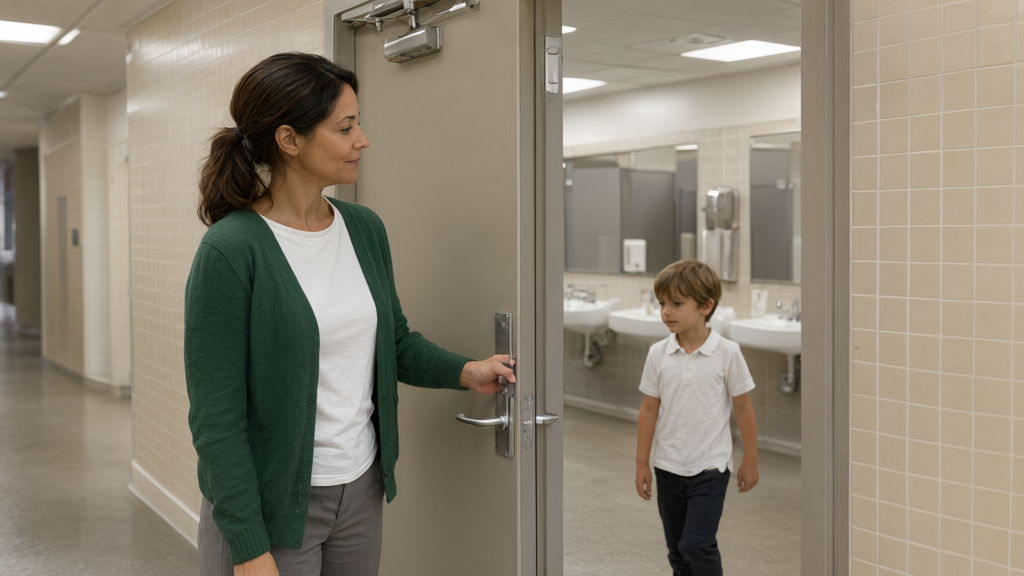
Under Michigan House Bill 4024, a parent or legal guardian may enter a multiple-occupancy restroom or changing area designated for the opposite sex only to accompany a student who requires assistance. The primary condition for this exception is that the area must be cleared of all other students before the parent or guardian enters with the child.
What the bill or law says
The proposed legislation, known as the Student Restroom Privacy Act, generally restricts access to shared facilities based on the sex listed on a student’s original birth certificate [https://legiscan.com/MI/text/HB4024/id/3267622]. However, the text includes specific exceptions to this rule. One such exception permits an individual to access a facility designated for the opposite sex if they are accompanying a student who needs assistance.
The bill specifies that the person providing this accompaniment must be a school employee, a parent, a legal guardian, or an authorized caregiver. Crucially, the legislation mandates that this access is permitted only if the area is cleared of other students [https://legiscan.com/MI/text/HB4024/id/3267622]. This provision aims to balance the need for parental assistance with the bill’s broader goal of maintaining privacy in multi-person spaces.
How it works in practice
If this bill becomes law, schools would need to establish procedures to ensure these conditions are met. For example, if a young student requires help in a locker room or restroom that does not match their biological sex as recorded on their birth certificate, a parent could assist them. However, school staff would likely need to ensure that no other students are present in the facility at that time.
This means that spontaneous or casual entry by a parent into a busy communal restroom would not be permitted under this exception. The requirement to clear the area suggests that such assistance would need to be coordinated to avoid infringing on the privacy of other students who are using the facility according to the bill’s main rules [https://legislature.mi.gov/Bills/Bill?ObjectName=2025-HB-4024].
What the source does not answer
The current text of the bill does not specify how schools should define "needs assistance." It is unclear whether this applies only to physical disabilities, age-related needs, or other circumstances. Additionally, the bill does not detail the logistical process for clearing a large multiple-occupancy facility, such as how long other students might have to wait or who is responsible for verifying that the area is empty. The legislation also does not address what happens if a parent refuses to leave when other students arrive.